Jean-Paul Bertemes
When I was asked by EUSEA to contribute to the 25 years birthday blog I was honoured. When I then saw that they asked me to reflect on the developments over the last 25 years, I asked myself: do I look that old??
Twenty-five years ago, I was still sitting on the bench of a Luxembourgish high school. Living in a small village with more cows than people, I was thinking more about finally getting my driving licence than about developments in science communication and engagement.
On this point, I recommend the two posts by Janneke Voltman and Mikkel Bohm on how science communication has evolved over the past 25 years: from a less developed field, largely shaped by the deficit model and focused on getting research into the media, to nowadays discussions on public engagement and dialogue.
From “science and society” to “Science in society” and further…
Instead, I’d like to focus on the evolution I witnessed during my own career as a science communicator. After a few years as a freelance (science) journalist, I joined the Luxembourg National Research Fund (FNR) in 2011 – when the European Commission’s framework programme had moved from “science and society” to “science in society”, but not yet to “science with and for society”.
And yes, I can confirm the trend: since then, science communication has become increasingly recognised as essential, and the debates have grown more nuanced. Rather than mainly feeding research results to the media, institutions built more professional in-house communication, while dialogue and engagement formats grew in parallel. I saw communication departments expand, more public engagement initiatives and structures emerge, and – especially among young scientists – a growing interest in engaging with the public.

FNR Team
All of this also made our work more complex. And that’s exactly why exchanging with international colleagues matters: to compare approaches, share what works (and what doesn’t), and feel a bit less alone with the same challenges, needs and motivation.

My first EUSEA conference in Vienna in 2019
Why we joined EUSEA? And why you should too…
We joined EUSEA for many reasons, but above all for the European perspective. In Luxembourg, we know we’re small (though still 14 square kilometres bigger than Saarland!!). So we naturally look to our European neighbours and think internationally. But there was another reason: Luxembourg built its research system almost from scratch – the Ministry of Research dates only to 1999, and the University to 2003. In science communication and public engagement, we have also built a lot, and wanted to share this with other partners and put Luxembourg on the international map of science communication. Through our close links with our German colleagues at “Wissenschaft im Dialog”, Markus Weisskopf – then EUSEA president – encouraged me to attend a EUSEA conference.
My first EUSEA conference was in Vienna in 2019, and I felt at home almost immediately. Compared to ECSITE or ESOF it was a smaller event, but in the best possible way: familiar faces, closer conversations, and a community where you don’t stay a stranger for long. And nice evenings of Karaoke in the nights…
From the start, EUSEA felt like the right international home for the FNR’s public engagement work. I totally recommend joining: you enter a highly motivated community that genuinely stays in touch – plus you get access to training, peer exchange, visibility, opportunities to join European projects, and collaborations that often last well beyond a conference badge.
Today’s challenges of public engagement and science communication
On today’s challenges in science communication, I fully agree with what my colleagues wrote in the first blog posts: misinformation, polarisation, distrust in institutions, and the disruptive effects of AI and digitalisation. I would add one more: the declining reach and funding of high-quality science journalism.
I’ve been following with great interest the rise of structures like Science Media Centres. In Luxembourg, we built the platform www.science.lu, which – in the absence of specialised science journalism – partly fills that role by popularising science.

Luxembourg Science Centre
Some of our content is also picked up by media outlets, building trust over time. That’s good – but it also raises a journalism question: what happens if institutions have more resources for communication than journalists do? How big is the risk of overpromising our research if institutions are more and more under pressure to get funding? And how do we respond to new trends in digital communication? Articles and videos alone are no longer enough. We now need formats that reach diverse audiences on social media in ways that match how they actually use it. While still being trustworthy, and able to compete with shocking misinformation and fake news.
At FNR, for example, we launched the edutaining format “TAKE OFF”, inspired by the Estonian show “Raket 69”: youngsters compete in science challenges, mixing fun and emotions with science education, broadcast on TV and across YouTube, Instagram and TikTok. We also run “Ziel mir keng”, which I co-present and write: a deeper dive into science topics relevant for society, bringing the scientific perspective into Luxembourg’s public debate (TV, YouTube, Instagram, Facebook and TikTok). But with so much fake news and misinformation on social media, how far can we really reach?

Explain science to policymakers
Another topic I care a lot about is communicating science to policymakers. I had the chance to launch, with the FNR, the Luxembourg Pairing Scheme in collaboration with the Luxembourg Parliament, which helped pave the way for a research service within Parliament, where we served as advisors during the implementation phase. I was also involved in the COVID-19 research task force, when researchers and policymakers had to work hand in hand under real pressure. That experience taught me how crucial it is to take this audience seriously: instead of blaming politicians, we need to understand their working reality, the speed at which decisions are made, and how science and science communication have to adapt to be useful.
I could go on with many more examples, but the good news is: we’ll soon have plenty of time to dig into all of this: during the…
Next EUSEA conference in Luxembourg!!!
We’re incredibly happy (and slightly nervous) to host the next EUSEA conference. Especially as it also marks EUSEA’s 25th anniversary. No pressure… except that we may have promised cows, cooked cheese, wine and beer (and yes: the Luxembourgish superhero Superjhemp can fly after eating cooked cheese. And no: we don’t know yet, how we are going to bring a cow to the conference…but we’ll find a way, promised!).
And fantastic news: so far, we have over 170 registrations! The biggest EUSEA conference so far. This also marks the promising future of this lovely community.
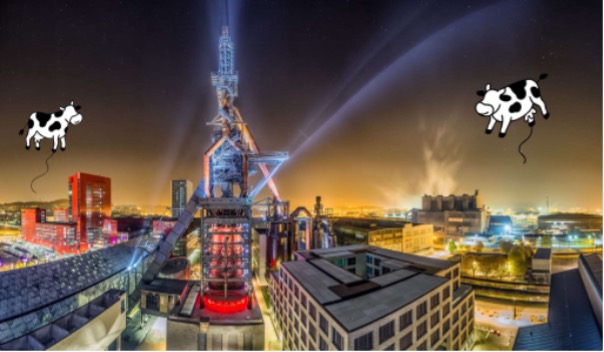
Here they are: some cows floating around the beautiful blast furnaces of Belval, the campus where the industrial past of Luxembourg merges with its future in science and research
We’re organising it with the Luxembourg National Research Fund (FNR) and the University of Luxembourg, which builds on our earlier collaboration to highlight science communication efforts in Luxembourg internationally through a science communication book (50 Essentials on Science Communication), alongside many European contributors – some from EUSEA! Do check your goodie bag in Luxembourg… there might be a small surprise inside.

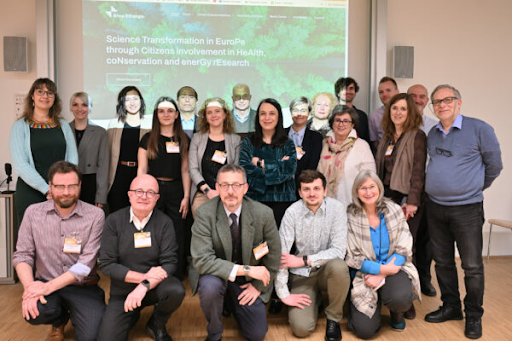
EUSEA visits Luxembourg in January 2026 – Editor’s note – I do realise how creased my shirt is!
For the conference, my colleagues Didier Goossens (FNR), Serge Haan and Giulia Cesi (University of Luxembourg) and I, together with the lovely EUSEA board and Secretariat, wanted to be a bit more critical and to change perspective. At EUSEA, you meet inspiring people who all believe in engagement, which is wonderful, but it can also become an echo chamber. Outside our bubble, the story may look different: politicians may be overloaded, researchers may be stretched thin, and many people simply have other daily worries. Our aim is to look beyond self-congratulation and make space for views, even critical ones, that might have a point.
Under the theme “In Other Words and Other Worlds: Confronting Assumptions for Better Engagement”, we’ll take a deliberately critical look at the assumptions that quietly shape our work. Using Luxembourg’s role as a crossroads of cultures and languages, we’ll question our habits, learn from each other’s realities, and rethink what better engagement could look like.
To conclude, let me quote Einstein – because we probably don’t do that often enough in science communication. Back in 1905, he said, “If you haven’t done so yet, become an EUSEA member and register for the 2026 conference in Luxembourg.”
Cheers,
Jean-Paul
Author:

Jean-Paul Berteme – Head of Science in Society – Luxembourg National Research Fund (FNR)