As EUSEA celebrates its 25th anniversary, it is a good moment to look back not only at the association’s development, but also at the people and ideas that have shaped it along the way. One of those people is Markus Weisskopf, whose connection to EUSEA stretches back more than a decade and reflects the spirit of collaboration that has always defined the network.
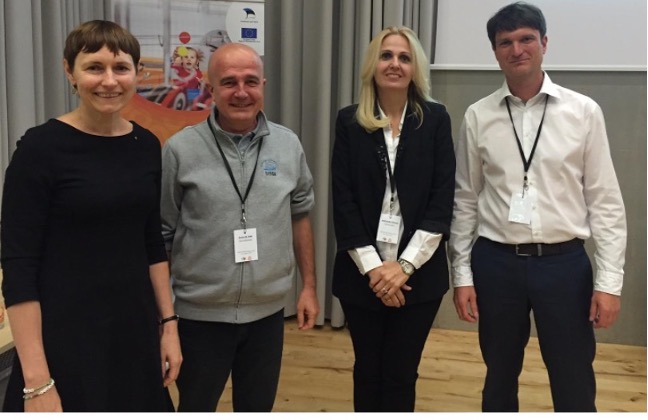
Cissi Askwall, Enrico Balli, and Aleksandra Drecun, together with President Markus Weisskopf, at the EUSEA General Assembly in 2016.
A network that helped me grow
I still remember my first EUSEA conference in Dublin in 2012 very clearly. At that time, I had only just started as Managing Director at Wissenschaft im Dialog, and I knew very few international colleagues in the field of science communication. It quickly became clear to me that EUSEA was not only a place to meet inspiring people, but also a network where I could learn a great deal from others who were working on the same challenges.
Over the following years, my contact with the network grew through the PLACES project, which was running at the time, and through the European Student Parliaments. These experiences strengthened my conviction that Europe needs strong professional networks in science engagement, networks that connect organisations, foster exchange, and create opportunities for collaboration beyond national borders.
Before the 2014 conference in Copenhagen, then President Leo asked me whether I would like to apply for a seat on the Board. I was elected for two years, and in 2016 I had the honour of becoming President of EUSEA for four years. That experience confirmed for me how valuable it is to have a European network that brings together organisations like Wissenschaft im Dialog and supports both practical exchange and strategic cooperation.

Cissi Askwall, Annette Klinkert, Philipp Burkard, Enrico Balli, Aleksandra Drecun and Markus Weisskopf
New challenges, same need for connection
An organisation like EUSEA is more important today than ever before. European cooperation remains essential, and that applies especially to countries that are currently only candidate members. In that sense, it was a wonderful sign that the 2024 conference took place in Georgia. It showed that EUSEA is looking not only inward but also outward – toward inclusion, exchange, and the future of science engagement across Europe.
Science communication itself has also changed significantly over the past 25 years. Back then, the main focus was often on encouraging young people to become interested in STEM. EUSEA, after all, began as a network of science festivals. Today, the field is broader, more complex, and more demanding. It is about engaging publics in discussions on controversial topics, responding to misinformation, and building trust in science and research.
That requires expertise, reflection, and above all, exchange. No one has all the answers, and that is exactly why networks like EUSEA matter so much. They provide a space to share experience, test ideas, and learn what actually works in different contexts.

Aleksandra Drecun, Markus Weisskopf, Philipp Burkard, Annette Klinkert, Enrico Balli and Cissi Askwall
EUSEA keeps evolving
What makes me particularly proud is that EUSEA has managed to build a new core while preserving its original spirit. In the early days, the network was strongly shaped by science festivals. Over time, new organisations joined, and many of the original members evolved as well – some started organising competitions, others moved more strongly into digital activities.
Together, we then managed to preserve the old spirit of EUSEA whilst also bringing in new topics, new institutions and new people. That balance between continuity and change is, for me, one of EUSEA’s greatest strengths.
Why join EUSEA?
To anyone thinking about becoming a EUSEA member, my answer is simple: go for it. 😉 Especially in times like these, it is incredibly valuable to talk to people who are working toward similar goals and facing similar challenges.
What has always struck me about EUSEA is the open and familiar atmosphere. It is a network where honest exchange is possible, where people listen to each other, and where practical ideas are shared generously. Just as valuable are the perspectives from countries and contexts with which we may not usually have much contact. Whether in Romania, Georgia, or Egypt, I have often seen challenges that made our own seem small – and solutions that were creative, practical, and worth learning from.
That, to me, is the real value of EUSEA: it brings people together, strengthens the field, and reminds us that we are better when we work together.
Author:

Markus Weisskopf – Former EUSEA President and Board Member