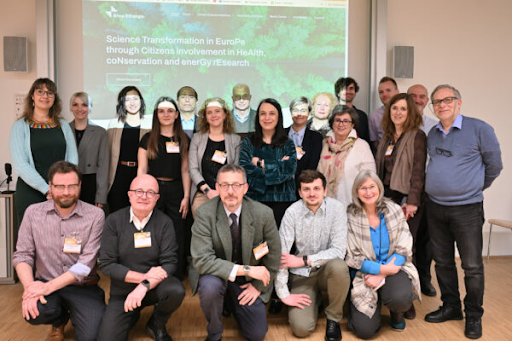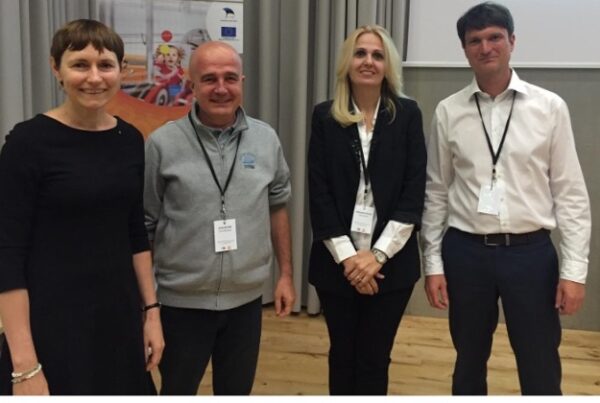
Following the adventures of our University of Glasgow members as they explore, learn, and make an impact. This article was originally written for the #UofGEngage Forum Blog in December 2025.
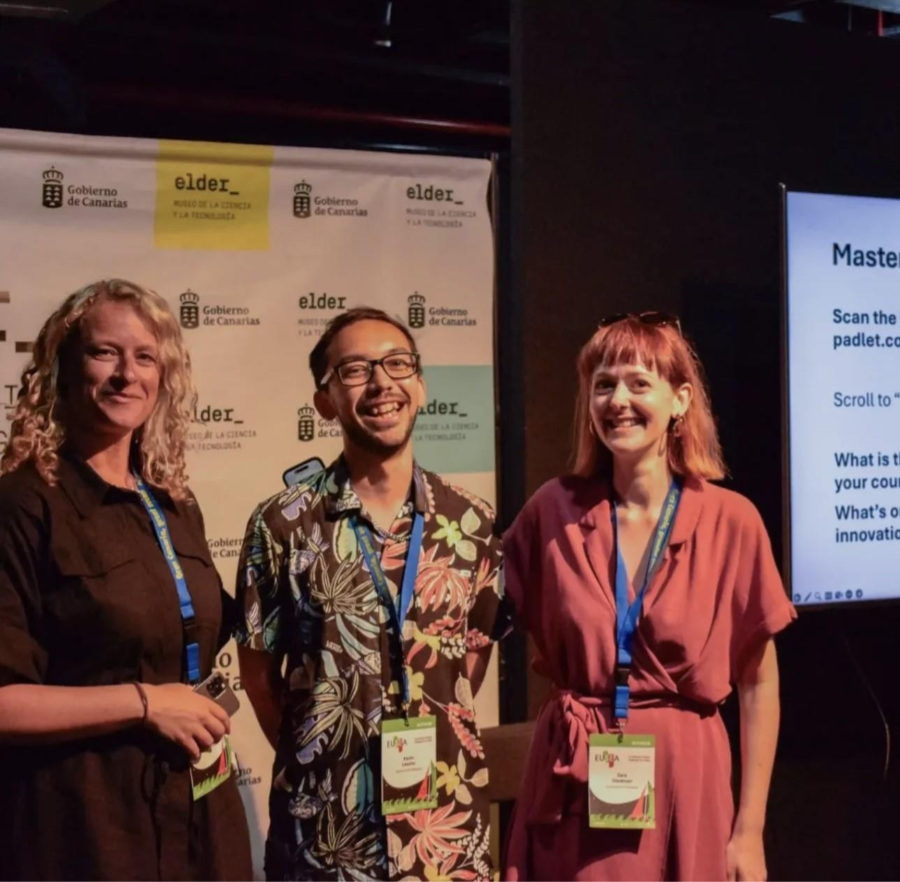
This spring, public and community engagement colleagues Zara Gladman (Research Services Directorate), Kevin Leomo (College of Arts & Humanities), Debbie McNeill (Glasgow Science Festival, College of Medical ,Veterinary and Life Sciences) and Ken Skeldon (Research Services Directorate) represented the University of Glasgow’s fantastic engagement work at two international conferences. Here they share reflections from connecting with colleagues from across the globe.
Tell us about the conferences
EUSEA is the European Science Engagement Association, an organisation dedicated to promoting and enhancing public engagement with research. The term ‘science’ is the European definition, which is inclusive of all research, including arts and humanities. The University of Glasgow has been a member of EUSEA since 2023 (with benefits like conference discounts extended to all staff and students). The annual EUSEA conference brings together practitioners, educators and researchers from across Europe. This year it was hosted by La Palma Research Centre, based in Gran Canaria.

The PCST (Public Communication of Science and Technology) Network is a global academic and professional organisation in the field of science communication. The PCST seeks to promote new ideas, methods, intellectual and practical questions, and perspectives on the communication of science and technology. This year the PCST was hosted in Aberdeen, Scotland.
What brought you to the conferences?
KEN: I had an active role in both conferences, which by coincidence, ended up being only two weeks apart despite being planned over several years!
For PCST, my role goes back to 2016 when my team at the University of Aberdeen led the successful bid to host the conference in Scotland – its first time to the UK and originally planned for May 2020! We were drawn to PCST for two reasons. Firstly, it is a truly global grassroots network including strong representation among LMIC, Africa and Asia, which brings a richness of contexts, cultures and experiences unlike most other public engagement gatherings. Secondly, the PCST network comprises both practitioners and scholars in almost equal measure, making it unique in connecting research and practice.
For EUSEA, my role is two-fold: firstly as a member, and secondly, in my current capacity as the EUSEA President. I was first drawn to EUSEA partly due to the relative intimacy of the network – it is large enough to be representative of multiple actors and geographics (~120 members over 31 countries) while of a size that makes it possible for members to get to know one another and avoid getting ‘lost in the crowd’.
ZARA: I was involved in co-delivering two sessions at EUSEA. One with Kevin and Debbie (I’ll let them tell you more). The other was focussed on sharing learning and challenges associated with evaluating large-scale festivals like European Researchers’ Night (ERN). I’ve been responsible for leading the University of Glasgow (UofG)’s contribution to ERN – ‘Explorathon’ – since 2019. At EUSEA it was great to meet and collaborate on a session with my equivalents in other countries (Sweden, Malta and Spain), which generated a lot of discussion. At PCST I gave a short talk on St Mungo Square – the large outdoor space on the new Western campus, flanked by research buildings – and shared how UofG staff and students working with communities to activate this space and programme creative engagement events, from ceilidhs to sustainably-powered music festivals.
KEVIN: Attending EUSEA was the most recent part of my journey as a public engagement practitioner, which I started during my PhD (with encouragement from Zara to get involved in Explorathon!). The University of Glasgow has a robust Public & Community Engagement Group comprised of public and community engagement professionals from across our institution. We’ve done a lot of work over recent years strengthening the position of our group, as members are often working individually or in very small teams. We also work together throughout the year on initiatives like Explorathon and often programme events and activities very collaboratively. Attending EUSEA was the chance to fly the flag for public engagement at the University of Glasgow, share our individual and collective work, and to meet our European counterparts!
DEBBIE: I worked with Zara and Kevin on our session ‘Making Waves in Public Engagement’. This gave us the opportunity to share: 1) how UofG has built a strong network of engagement professionals, through the Public and Community Engagement Group described by Kevin 2) how partnership-building underpins our community engagement work and 3) how campus developments – such as creation of St Mungo Square – are opening up new opportunities for barrier-free engagement. In particular from my own experience at Glasgow Science Festival (GSF), I shared a case study of collaborating with the Kinning Park Complex, and how we facilitated community-led content for a Halloween event.

What did you gain from participating this year?
ZARA: Public engagement professionals – particularly those working in events or time-intensive community projects – are often so focused on project delivery that they forget to share, reflect on and celebrate their work. Internally, I think Glasgow does a decent job of this, I’m really happy to be a part of the Public and Community Engagement Group. But I think we could do better at sharing outwards, and EUSEA and PCST were the perfect opportunity to do this. Equally, I really valued the chance to sit back and listen. I learned about – and was inspired by – a brilliant range of engagement initiatives. There was the artist-led ‘Hopes and Fears Lab’ (Cambridge, UK), a playful approach to stimulating conversations about science ethics; Research Ireland’s collaboration with TikTokers (relevant to my interests!) to share research creatively and promote Science Week; the A.L.I.C.E. project (Turin, Italy), a collaboration between law students, women prisoners and theatre makers to highlight the challenges faced by incarcerated women; and dialogue sessions between scientists and traditional healers in South Africa, to bridge the gap between indigenous knowledge systems and “Western” science, which has led to new collaborative research projects (led by Mamoeletsi Mosia, National Research Foundation of South Africa).
The biggest thing I took home with me was an amazing sense of community with colleagues across the world, who are facing many of the same challenges. I’m made new connections that I’ll definitely be following up on.
DEBBIE: Despite working in public engagement for over 20 years, this was my first time attending an international PE conference. As Zara said, we are often so focused on delivery of projects that it’s difficult to find time to share and network. I’m so glad that I did. Sharing my experiences of Glasgow Science Festival – and in particular, the importance of ethical partnerships – reaffirmed my passion for what we do. The chance to connect with my equivalents in other countries was incredibly valuable. Among the delegates was Julia Brink, who leads a large-scale festival in Sweden that will have its 20th birthday the same year as Glasgow Science Festival. I think some twin-town celebrations are in order.
KEVIN: I really enjoyed learning about different approaches to public engagement from colleagues across Europe. I’m always thinking about arts & humanities representation and was glad to present some of the brilliant programming and public engagement work that happens across the College of Arts & Humanities. I’m also passionate about anti-racism and tackling structural barriers within Higher Education, so it was great getting to speak about these vital issues with others working in these areas across Europe. Getting to collaborate with Debbie and Zara on our interactive workshop was also a real joy. A key takeaway for me was a changed perspective on the public engagement that occurs at University of Glasgow – there are always improvements to be made, but I truly believe we’re sector-leading in the field!
KEN: Both conferences gave a wonderful opportunity to reconnect with friends and colleagues from previous roles.
The rescheduling of PCST from 2020 to 2025 gave us more time to attract a huge, worldwide audience to the event and to consolidate budgets: we’re proud to have awarded almost 40 travel bursaries. Alongside my organisational role, I chaired sessions and presented on the UofG’s Solutions for Change and Open Lab initiatives.

A lot of EUSEA’s work aligns with what is happening in the European research landscape, which is really beneficial to connect with – for instance in the (Horizon) Framework Programmes and evolving European Research Area (ERA). At the Gran Canaria conference I chaired a plenary panel debating the findings of the recently published European Commission’s Mutual Learning Exercise report on PE within R&I.
What was your most memorable moment?
ZARA: At both EUSEA and PCST, karaoke featured heavily in the social itinerary. There was something quite amusing – and lovely – about singing Spice Girls, The Cranberries and Eminem alongside international colleagues; then witnessing the same people giving quite serious talks the following morning. I like the idea of connecting as humans first, then colleagues – the same applies for public and community engagement.
KEVIN: I loved the EUSEA conference dinner, set in the beautiful Doramas Park, getting to try some delicious Canarian delicacies (I still want to try recreating the vegan leek savoury flan!). Another highlight was hearing school children speaking Silbo Gomero, a language which translates Spanish to whistle tones, originally spoken by the Guanches, the indigenous Canarians.
KEN: PCST in Aberdeen was the culmination of an almost 10-year long journey for me, and so it was very nostalgic to be back in the city where I lived for over 8 years and did so much public engagement. Seeing and working with members of my old team, particularly Heather Doran, and other colleagues from that time was wonderful, and to be able to welcome over 600 people from all over the world to the conference surpassed all our expectations! I also enjoyed connecting with many colleagues from over the years who I hadn’t seen in some time.
For the EUSEA conference, it was my first as President of the Association and so a very special occasion for me to welcome everyone to the gathering. It was also the last for EUSEA’s Director of 9 years, Annette Klinkert, and I couldn’t have wished for a brighter, more positive send off! It was also great to see more of my colleagues from Glasgow in sunny Gran Canaria, presenting their amazing work.
DEBBIE: The conference ran just a few weeks before the Glasgow Science Festival, so it had been a difficult decision to try and carve the time out to attend. I had booked a lovely apartment with a balcony overlooking Las Canteras beach. In between an early morning filled with work emails and heading off to join colleagues for a day of fascinating talks and workshops. I had this lovely moment of quiet calm, looking out to sea and drinking a coffee, reflecting on what a privilege it is to be part of the engagement world.
What’s next for engagement at Glasgow?
ZARA: I recently submitted our Horizon Europe funding application, to hopefully bring Explorathon back again in 2026 (crossing fingers!). I’m also excited to be a part of ‘Learn Together’, a new community-led training programme that aims to upskill researchers in ethical engagement.
KEN: I’m looking forward to May 2027 when the University of Glasgow will host the EUSEA conference in the ARC, following our successful pitch back in 2023! It will be an exciting opportunity to attract this vibrant European PE community to our doorstep and for our own activity and campus to shine.
KEVIN: I’m continuing to work on Thinking Culture, our year-round programme of critical and creative events centring the practice and research of our staff, students, and guest artists. I’m also very much looking forward to the third iteration of Creatives of Colour Festival which will take place in May 2026!
DEBBIE: After a record-breaking event in 2025, the call for ideas for Glasgow Science Festival 2026 is now open! This is our 20th birthday. I’m excited to celebrate, along with everyone who has made the festival a success through the years. You can submit your event proposals until 12 January 2026.
The EUSEA 2026 conference will take place in Luxembourg in May. Registration will open in February 2026. University of Glasgow delegates receive a discount due to EUSEA membership.
#EUSEA27 will be heading to Glasgow next year, and we are very excited to work with the team at the University of Glasgow after May to make your visit to Scotland as bonnie as possible. More details will be available later this year.