In 1997, science communication was still something of a fringe pursuit, tolerated rather than celebrated in academic circles, and largely absent from public life. Almost three decades later, it has become nothing less than a pillar of democracy. In this issue of our birthday blogs, we talk to Mikkel Bohm, one of EUSEA’s founding members and President from 2004–2006, to reflect on how a small group of passionate, slightly fearless Europeans helped build a movement, and why the work they started is more urgent today than it has ever been.
The early days…
Back in 1997, I worked as a press officer at the Technical University of Denmark, having a lot of fun getting university research pushed into the mainstream media. At that time, barely 30 years ago, popular science communication was far from being an integrated part of academic life and was often frowned upon. Universities had no or very small communications departments, so there was a lot of job satisfaction in getting science into the news.
That year, the director of the Danish Science Centre Experimentarium, Asger Høeg, came back from visiting the mother of all European science events: the Edinburgh Science Festival. In Scotland, they treated science as a cultural activity, just like art, theatre and music. They took science to the streets, not only presenting it to the general public but actually engaging in dialogue using formats borrowed from art festivals. Why not try this in Denmark? After all, science is a public activity, paid for by taxpayers to benefit society.
Inspired by this initiative, I quit my university job to join the team designing the very first National Danish Science Week from scratch in 1998 and soon became its director. It turned out to be a great success, and we still organise a school version of the science week every year, with more than 150,000 participating pupils.
Naturally, I was eager to draw inspiration from science festivals and science weeks in other countries, and after a few years, I began meeting interesting people who wanted to share experiences from science events. Key figures were Peter Rebernik (Austria), Joachim Lerch (Germany), Janneke Voltman (Netherlands), Magdalena Fikus (Poland) and Annika Lotzman-Dahl (Sweden). We were all young(er) and fearless, and full of enthusiasm for building what was to become the European Science Events Association (EUSCEA).

Jan Riise representing EUSCEA at PCST (Public Communication of Science and Technology) symposium in Beijing 2005
We were soon joined by Jan Riise (Sweden), Annette Smith (UK), Paula Havaste (Finland), Herbert Münder (Germany), Anne Riiser (Norway) and many, many more.
My first meeting with the group took place in Gothenburg in 2001, and later that year, we gathered with colleagues from across Europe in Vienna for the very first EUSCEA General Assembly. We were surprised to see how many people found our initiative relevant. Joachim became the first president, and Peter served as EUSCEA’s director for many years, spreading the word and bringing more and more countries on board. The idea of making science accessible in public spaces was on the rise, and our members were hungry to explore new, creative formats.

EUSCEA stand at Korean Science Festival 2006
I had the honour of serving as the second EUSCEA president from 2004 to 2006, and during these early years, we managed to secure EU funding to visit each other and document the many types of science events growing all over Europe, through programmes such as WONDERS and EUSCE/X (see Peter and Joachim’s blog). Being a relatively small organisation, we always kept things informal and often talked about the “family feeling” within the group. We were pioneering a new kind of science communication, and it was deeply rewarding.
The idea of science events also spread beyond Europe. The EU Commission often asked us to represent Europe, proud of our achievements and innovation in science communication.
We travelled extensively across Asia and the USA, presenting hands-on science with spaghetti and glue guns in South Korea, or gleefully making light bulbs explode in microwave ovens in the shopping malls of Shanghai.
Those were the days!
EUSEA is more important than ever
Our democracy is threatened by misinformation, populism and totalitarian ideologies. Informed citizenship depends on knowledge and critical thinking, and understanding science and the scientific method is an absolute prerequisite for safeguarding our way of life, and for addressing the complex challenges we face in terms of climate, health and digital transformation.
Back in 2001, there was no social media, no AI, no smartphones, no doom scrolling or brain rot. All the things that, for good and bad, take up so much of our time today simply did not exist. We worked almost entirely in the physical world, building science villages in town hall squares, staging pop-up lectures about the science of perfume in department stores, or creating dance shows with human molecules. The idea was, and still is, to create dialogue in non-threatening spaces where people already are: shopping centres, sports events and so on.

Mikkel Bohm representing EUSCEA at EU Science Communication conference, Brussels 2006
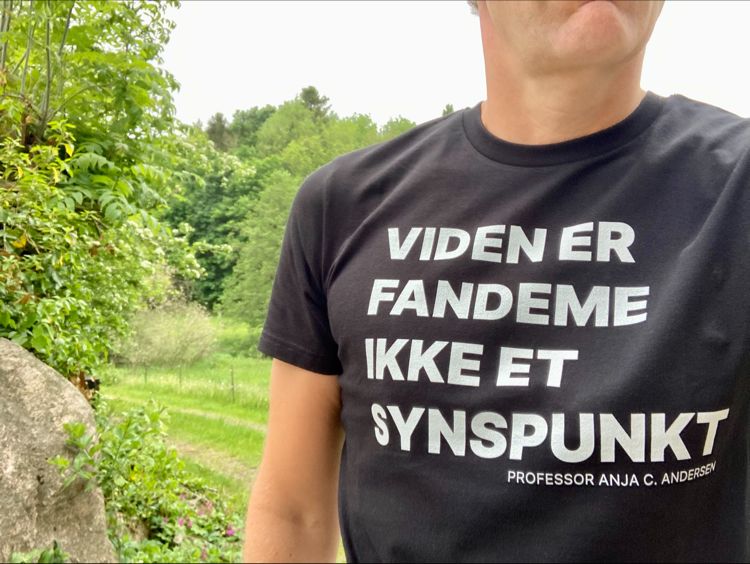
#videnerfandemeikkeetsynspunkt
This was illustrated vividly a few years ago in Denmark, when a new television programme by the Danish Broadcasting Corporation tricked scientists into discussions in which the interviewer, unknown to the scientists, was voicing conspiracy theories (flat earth, moon landings). The intention was entertainment, but the dangerous effect was that science could be seen as just another point of view.
But scientific knowledge is not opinion. It is the best understanding of the world available to us at any given time, self-critical and dynamic, as opposed to dogma. The consequences of the alternative are plain to see in totalitarian and populist regimes, where facts and critical thinking are suppressed. As Janneke mentioned in her blog, one of the scientists involved, Professor Anja C. Andersen, declared that “science is not a bloody opinion.” The phrase quickly became a hashtag (#videnerfandemeikkeetsynspunkt), was printed on T-shirts, and now appears on the shopping bag I use every day.
Today, much of our interaction takes place in the digital world, in chat groups and on social media, where identities can be blurred, videos can be faked, and misinformation can be spread through hybrid warfare by troll factories. Algorithms reward conflict and create echo chambers that amplify extreme opinions. Anyone can claim anything without editorial oversight, and scientific knowledge carries no more weight in a debate than mere opinion.
EUSEA must keep working to promote critical thinking and a scientific approach through dialogue, including in digital spaces. It is more important than ever. This is no longer simply about spreading a love of science, as our perhaps more innocent approach was 25 years ago. The stakes are higher now, and they are fundamental to safeguarding our democracy and values.
Happy to see EUSEA in great shape
Today, I work mainly within formal education as director of Astra, the Danish Science Education Centre. We run student citizen science projects, camps for the most engaged young people, science weeks for everyone, and a wide range of conferences and networks for teachers.
I have moved some distance from the original idea of “street science”, but Astra remains a member of EUSEA, and I follow the organisation’s excellent work from the sidelines.
I am so glad to see that the organisation we started all those years ago is still relevant and going strong. The community spirit seems very much alive, and EUSEA continues to be the network for anyone working professionally in science communication and science engagement.
Here’s to the next 25 years!

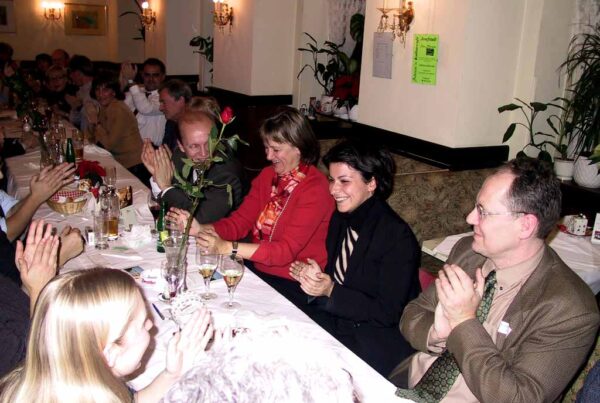
Jan Riise, Herbert Münder, Peter Rebernik and Mikkel Bohm in Iceland 2006
Author:

Mikkel Bohm – EUSEA President 2004-2006