In the second of our series of birthday blogs to mark 25 Years of the European Science Engagement Association, we asked Janneke Voltman, one of EUSEA’s founding members, to reflect on the association’s role in the early years through to the present day – and why as a science communicator based in the Netherlands in the early 2000s, the creation of a network was so timely.
From communication to consensus building
As a science communicator working in the Netherlands, my connection to EUSEA (or EUSCEA, or, more precisely, still in formation) began with an invitation from Peter Rebernik to come to Vienna to discuss the possibility of exchanging experiences in science communication. From day one, the contact has always felt both professional and personal. We had meetings in several European cities and combined work with dinners and other activities with partners and sometimes even children.
Together, we were searching for ways to move beyond traditional outreach, beyond simply explaining science. We were aware that simply expressing our own love for science and technology is not enough to convey that enthusiasm to others. On the contrary, it can be counterproductive.
In the Dutch context, where collaboration and consensus-building are part of our DNA (we call it the ‘polder model’), these principles resonated strongly. I suppose every EUSEA member has the same feeling of recognition I had at that time: across Europe, colleagues are facing the same challenges, fostering involvement and real dialogue between researchers and the public.
EUSEA provided exactly that: a home for people who believe science should not sit in an ivory tower, but live in society. EUSEA offered me inspiration and a community of peers who were asking the same questions: How do we build trust? How do we include unheard voices? How do we make science meaningful in people’s everyday lives?

EUSEA remains essential because the challenges we face today – climate change, health crises, AI, misinformation – do not stop at national borders. Neither should our solutions. The network continues to provide a shared space for learning, experimenting, and shaping the future of public engagement with science.
Adapting to changing expectations and opportunities
Public engagement with science has changed over the past 25 years. In the 1990s and 2000s, I worked on science weeks and similar events both at a university and nationally. It was all new and exciting, visitor numbers increased every year and creative initiatives like national experiments (can we cause an earthquake if all Dutch children jump at the same time?), Science cafes, student events with professors in gowns and even a science quiz broadcast on Christmas Day were launched.
Let’s be clear: the fun part of science communication is still essential. But both public attitudes and science have changed. Today’s biggest challenges include declining trust in institutions, the spread of misinformation and increasing polarisation. More than 25 years ago, there was a need to engage more diverse communities, not just those already interested and well educated. No need to say that the COVID-19 pandemic made it clear that trust is hard to gain but easy to lose. Transparency, relationship building, and active approaches are part of scientists’ and communicators’ responsibilities.

In the Netherlands, we see growing expectations that scientists explain the societal impact of their work and engage ethically with citizens. Compared to 25 years ago, engagement is no longer optional. It is expected, and rightly so.
The importance of shared values
I have the impression that EUSEA has grown along with the field itself. From its early days as a network connecting science festivals and communicators, it has evolved into a platform that promotes inclusion, innovation, and reflection.
Nowadays, I work in a different field; my focus is lifelong learning. Our challenge is how to inspire adults to continue developing themselves throughout their careers and how to lower the threshold to vocational education. In the Netherlands, we seem to agree on the answer: that is not a supply problem. It is a connection problem. At that point, I still remember the lessons I learned 25 years ago from my work in science communication.
EUSEA can be proud that it has encouraged experimentation and exchange, and fostered a culture of (lifelong 😉) learning. For me, EUSEA represents a commitment to doing science communication better. Not just louder, but more thoughtfully, more ethically, and more collaboratively. And not in the least: with a lot of fun and personal contacts.
The importance of community: colleagues and friends for life
At a time when science is both more powerful and more contested than ever, we need strong, connected communities. EUSEA can provide that. So, to any individual or organisation considering EUSEA membership, my message is simple: join the conversation!
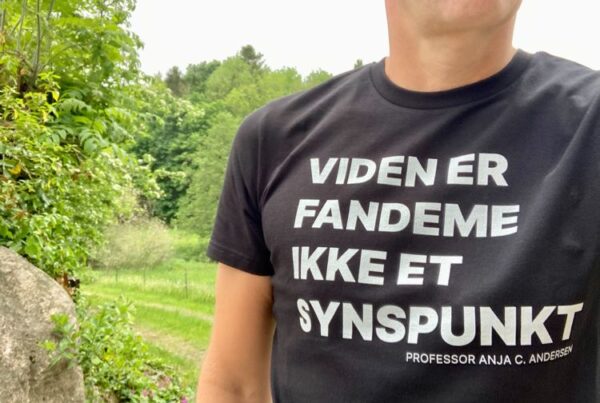
My contact with former EUSEA colleagues is no longer frequent, but nonetheless warm. A few years ago, I saw Mikkel Bohm (from Denmark) wearing a t-shirt with a citation of Danish astrophysics professor Anja C. Andersen: “Viden er f*ndeme ikke et synspunkt”. A true word (just look up the translation…). I immediately bought that shirt, and it has been a perfect conversation starter with Dutch friends and colleagues. Maybe Mikkel can also write a birthday blog and explain the story behind the citation?
I appeal to continue to think European. Membership of EUSEA is a link in that chain. EUSEA is more than a network. It is a learning community and a platform for mutual inspiration for meaningful science–society relationships. Public engagement thrives when we learn from each other!
Author:

Janneke Voltman, – EUSEA founding member